How Does a Basic Micro Switch Work in an Electric Screwdriver?
The basic workflow of an electric screwdriver is as follows: After the user presses the trigger, the trigger mechanism actuates the internal micro switch. The micro switch changes the internal contact state and sends an electrical signal to the control circuit, which then drives the motor.
In this process, the Basic Micro Switch is a crucial interface connecting the trigger mechanism and the electrical control circuit. It can be used for trigger detection, motor activation, and, depending on the specific circuit architecture, participates in some forward/reverse control. This article will introduce its core function: converting the user's mechanical trigger operation into an electrical switching signal, allowing readers to understand its working principle.
What is a Basic Micro Switch?
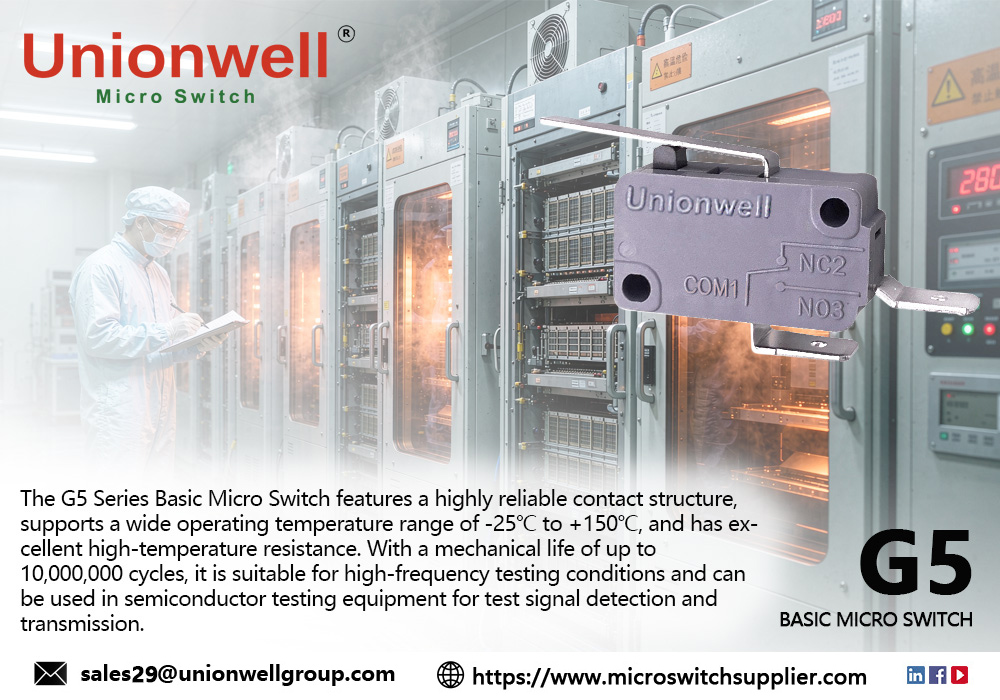
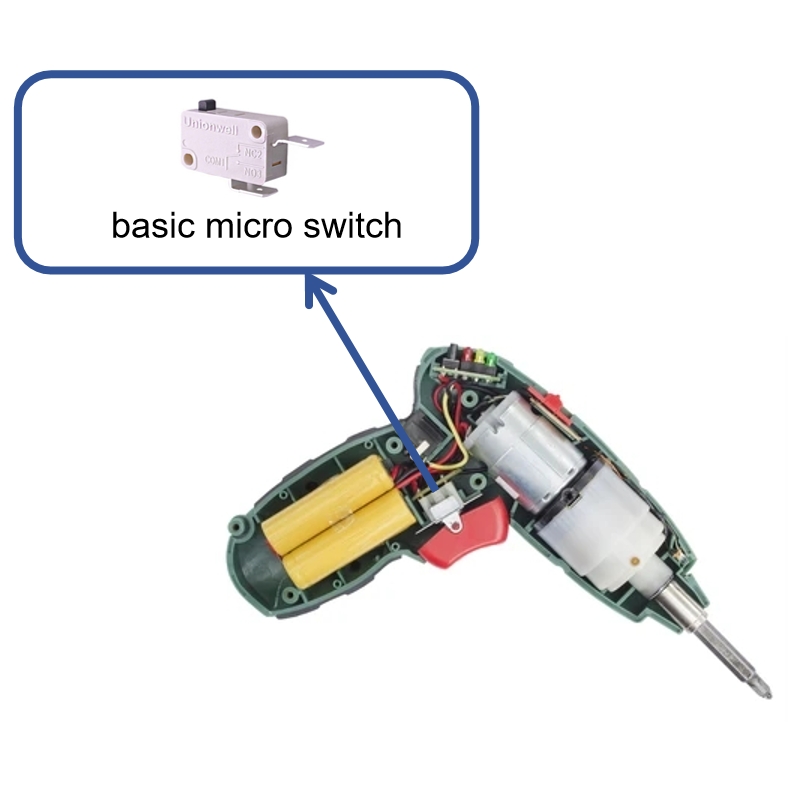
A Basic Micro Switch is a mechanical switch employing a snap-action mechanism. An external mechanical action actuates the actuator, causing the internal contact mechanism to quickly switch states within a specified operating position. It is typically installed near the trigger mechanism of the electric screwdriver.
How Does a Basic Micro Switch Work?
The working process of a Basic Micro Switch can be understood as a mechanical transfer from the actuator to the contact. When the trigger is not pressed, the actuator is in its initial state, with COM and NC connected and NO disconnected. When the user presses the trigger, the trigger mechanism pushes the actuator, and the displacement is further transmitted to the Snap Action Mechanism. Upon reaching the specified operating position, the Moving Contact quickly switches, changing the connection state between COM and NO or NC.
COM stands for Common Terminal, NO for Normally Open Terminal, and NC for Normally Closed Terminal. Therefore, the user operates the mechanical movement of the trigger, while the control circuit receives the contact state change; the Basic Micro Switch is the interface connecting the two.
How Does a Basic Micro Switch Work in an Electric Screwdriver?
Trigger Presses the Basic Micro Switch
When the user presses the trigger, the trigger mechanism generates mechanical displacement, which is transmitted to the actuator of the Basic Micro Switch through contact surfaces, push rods, and other structures. During design, three parameters need to be carefully matched:
- Operating Force: Excessive operating force increases trigger pressure and mechanism load; insufficient force requires assessment of the risk of false triggering due to insufficient pre-pressure.
- Actuation Position: The trigger must push the switch to complete the action at a reasonable position to avoid insufficient travel or premature over-compression.
- Travel: Pretravel determines the displacement required for the actuator to reach the action position, while over-travel provides additional range of motion after the action.
In other words, the trigger and Basic Micro Switch need to comprehensively match the mechanical systems of Force, Position, and Travel to ensure stable operation of the Micro Switch and prevent excessive mechanical load on the actuator.
Basic Micro Switch Sends an Electrical Signal
When the actuator reaches the specified operating position, the internal contact mechanism quickly switches. If the micro switch uses an SPDT configuration, COM and NC are initially connected. When the trigger is pressed to the specified position, the movable contact switches from NC to NO, and the circuit state changes accordingly. The control circuit detects this state change to determine whether the trigger has been pressed.
The Electrical Signal Activates the Motor
When the control circuit receives the signal from the Basic Micro Switch, the controller controls the motor according to preset logic. At this time, the micro switch acts as an input component, providing feedback on whether the trigger has reached the specified position or has been released.
The complete working chain is: Trigger → Basic Micro Switch → Electrical Signal → Control Circuit → Motor Driver → Motor. This separates the mechanical input from the motor power stage, allowing the micro switch to select the appropriate contact configuration and electrical characteristics according to circuit requirements.
What Does a Basic Micro Switch Control in an Electric Screwdriver?
Basic Micro Switch for Trigger Detection
Trigger detection is the primary application of a Basic Micro Switch. Pressing the trigger mechanically moves the actuator, switching contacts once it reaches the operating position. The control circuit confirms the trigger action via the NO, NC, or COM status and obtains a clear electrical state.
Basic Micro Switch for Motor Start and Stop
A Basic Micro Switch can participate in Motor Start/Stop Control. Pressing the trigger switches contacts and sends a signal to the control circuit, which can then start the motor or allow the motor driver output. Releasing the trigger resets the actuator, restores contacts, and the control circuit, upon detecting the release signal, can stop the motor drive or PWM output.
What are the advantages of using a Basic Micro Switch in Electric Screwdrivers?
Compact Size
The handle of an electric screwdriver needs to accommodate components such as the motor, gear mechanism, battery connection, PCB, and trigger mechanism, resulting in limited installation space. A Basic Micro Switch can be installed near the trigger, shortening the connection distance between the mechanical components and the circuitry. However, smaller size is not necessarily better; electrical rating, operating force, terminal strength, and mechanical life must also be considered.
Fast Snap Action
Snap action is a core feature of the Basic Micro Switch. After the trigger pushes the actuator to the action position, the internal contact mechanism quickly completes the transition, forming a clear switching point, improving the stability of trigger detection. Simultaneously, rapid contact transfer shortens contact arcing duration, helping to maintain contact switching consistency and long-term electrical performance.
Reliable Repeated Operation
The electric screwdriver's trigger operates frequently; therefore, the reliability of the Basic Micro Switch requires a comprehensive evaluation of Mechanical Life, Electrical Life, Actuator Durability, and Contact Wear. Mechanical Life reflects the number of mechanical actions, while Electrical Life is also affected by Voltage, Current, Load Type, Switching Frequency, and Contact Arcing. Lifespan should be assessed in conjunction with the actual trigger cycle and electrical load.
Flexible Contact Configurations
The Basic Micro Switch offers different contact configurations such as NO, NC, and COM. The same Micro Switch platform can adapt to different control architectures. When multiple status signals need to be output, multi-contact structures such as SPDT can be used. Therefore, the contact configuration should be determined comprehensively based on the schema, controller input logic, and actual load.
How to Choose the Right Basic Micro Switch for an Electric Screwdriver?
Operating Force and Actuation Position
The operating force must first match the trigger mechanism. Excessive operating force increases the user's pressing force and the mechanical load on the trigger hinge, spring, and other structures; insufficient force requires verification of pre-pressure stability to avoid false triggering due to vibration or tolerance variations.
Simultaneously, the actuation position should be within the effective travel of the trigger and allow sufficient over-travel margin. Therefore, selection should comprehensively evaluate the trigger force curve, operating position, pretravel, over-travel, and installation tolerances.
Electrical Rating
The electrical rating needs to be determined based on the voltage, current, and load characteristics of the motor control circuit. If the switch only provides a low-current signal to the controller, its load differs from that of directly switching the motor circuit. When directly controlling the motor, the inrush current generated during startup must also be considered; otherwise, contact welding, excessive arcing, or premature contact degradation may occur.
DC and AC loads should also be distinguished. The final selection should comprehensively consider parameters such as Voltage, Steady-State Current, Inrush Current, Load Type, Switching Frequency, and Circuit Protection, rather than simply choosing a higher current rating.
Mechanical Life
Electric screwdriver triggers are typically used frequently, therefore the mechanical life should match the expected trigger cycles. Furthermore, trigger force, actuator stroke, over-travel, installation deviations, lateral loads, and environmental conditions in actual applications can all affect the final lifespan. Therefore, a more reasonable approach is to first estimate the actual trigger cycles over the product's lifespan and then verify this against data provided by the micro switch manufacturer.
Actuator and Terminal Type
The actuator must match the trigger movement direction. For linear drive, a pin plunger can be selected; if direct drive is not suitable, a lamp, roller lamp, or other similar structures can be used. The actuator also affects Effective Stroke, Operating Force, and Mechanical Tolerance. Terminal Type depends on PCB Layout and Wiring Method; common types include PCB, Quick-Connect, and Solder Terminal.
Conclusion
In an electric screwdriver, the core operation of the Basic Micro Switch can be summarized as: Trigger Movement → Actuator → Contact Switching → Electrical Signal → Motor Control. It primarily converts the mechanical trigger operation into an electrical signal, which is then used by the control circuit to control the motor based on the specific architecture.
Therefore, when selecting a micro switch, key parameters such as operating force, actuator position, travel, electrical rating, and mechanical life should be considered to ensure a good match between the micro switch and the control circuit, thereby achieving stable trigger response and long-term switching reliability.
How Does a Basic Micro Switch Work in Semiconductor Test Equipment?
How Does a Subminiature Micro Switch Work in Automotive ETC?
Related Article