How to Find the Suitable Waterproof Micro Switches for Industrial Applications
When selecting an industrial micro switch, the biggest mistake is to base your choice solely on the machine as a whole. A switch installed inside a dry electrical control cabinet faces a completely different environment than one placed next to a machine tool workbench or in a wash-down area of a food processing plant. In the latter cases, the switch is exposed daily to elements like cutting fluids or high-pressure hot water. Using the same model for every location is problematic: it either leads to over-engineering and unnecessarily high costs, or results in product failure and potential safety hazards.
Therefore, when choosing a waterproof micro switch, you shouldn't focus exclusively on an "IP67" rating. While an IP rating addresses whether water can penetrate the device, other critical factors must also be considered: electrical parameters (will the contacts burn out before water even enters?) and mechanical parameters (can the operating mechanism reliably actuate the switch?). This article outlines a practical selection process, transforming the vague question of "do I need it to be waterproof?" into a clear, systematic decision-making method.
What Makes a Micro Switch "Waterproof"?
The operating principle of a waterproof micro switch is identical to that of a basic micro switch; both rely on a snap-action mechanism to rapidly open or close electrical contacts at a critical threshold. The key difference lies in the sealing—a design that keeps water, dust, and other contaminants out of the contact chamber without restricting the free movement of the actuator.
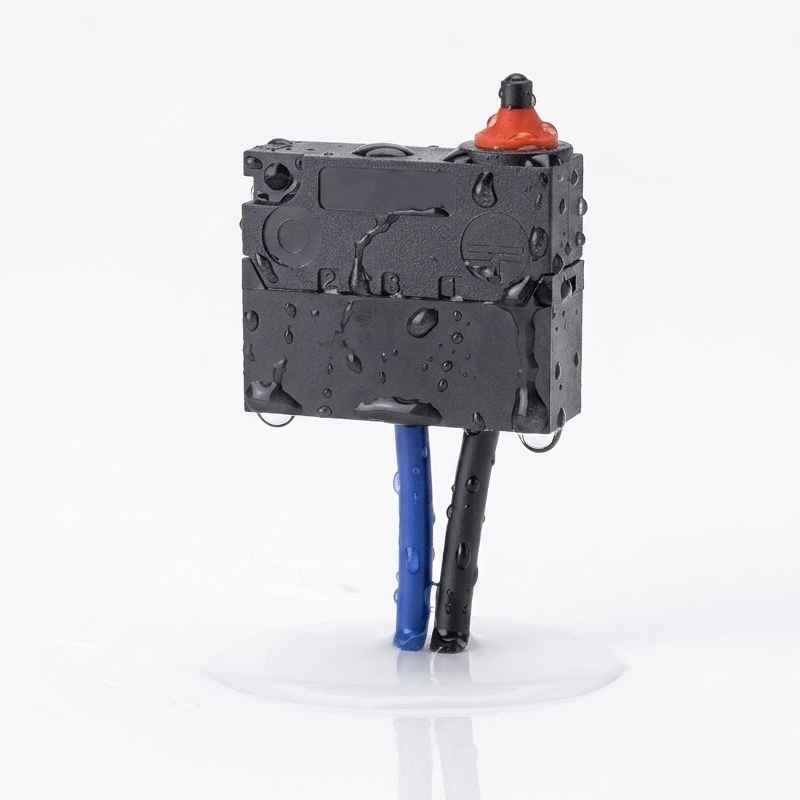
Four Sealing Paths for Micro Switches
Effective sealing involves four interconnected paths: the housing seams, the moving parts of the actuator, the terminal exit points, and the cable entry point. If any one of these paths is compromised, the "sealed" micro switch effectively loses its protection rating. Consequently, a high-quality industrial micro switch must ensure robust sealing at all four of these locations.
How to Read IP Codes for Waterproof Micro Switches
|
IP Rating |
Dust protection (first digit) |
Water resistance (second digit) |
Test conditions |
Permissible operating conditions |
Impermissible operating conditions |
|
IP54 |
Level 5: Restricts most dust without affecting operation |
Level 4: Protected against water splashing from any direction |
Water splashing test from all directions |
Indoor cabinets, surfaces occasionally exposed to splashing water |
involving rinsing, immersion, or the long-term accumulation of dust |
|
IP65 |
Level 6: Completely dustproof |
Level 5: Protected against water jets from any direction |
Low-pressure water jetting from all directions |
General outdoor installations, areas surrounding cleaning zones, or dusty environments |
involving brief immersion or exposure to high-pressure water jets at close range |
|
IP67 |
Level 6: Completely dustproof |
Level 7: Can be submerged in water for a short period |
Immersion at a depth of 1m for 30 minutes |
Floor-mounted equipment prone to water accumulation or components subject to occasional immersion |
involving long-term immersion, high-temperature steam, or the presence of cleaning agents |
|
IP68 |
Level 6: Completely dustproof |
Level 8: Can be submerged in water continuously |
Depth and duration to be agreed upon between the manufacturer and the user |
Underwater equipment or parts subject to prolonged immersion |
Any other conditions involving greater depth or longer duration that have not been explicitly agreed upon |
It should also be noted that a micro switch with an IP40 rating is considered "dustproof." While it does not offer waterproof protection, it prevents the ingress of solid foreign objects with a diameter of approximately 1 mm or greater, making it suitable for use in general equipment located in dry indoor environments.
Electrical Selection of Waterproof Micro Switches
Signal Circuits vs. Power Circuits
Signal circuits—such as those used for PLC digital inputs, position feedback, or reading the status of safety interlocks—operate at very low currents. In these applications, oxidation is a primary concern. Silver contacts are prone to forming a sulfide film under low-current conditions, which increases contact resistance and can lead to intermittent signal transmission; therefore, gold-plated contacts are recommended.
Conversely, for power circuits, it is necessary to evaluate steady-state current, inrush current, and switching frequency. Components such as contactor coils and solenoid valves are inductive loads; when disconnected, they generate a back-electromotive force (back-EMF) and an electric arc. Heaters, meanwhile, exhibit very low resistance during a cold start, resulting in inrush currents that can be several times higher than their steady-state operating current. These factors must be carefully considered during selection, rather than relying solely on the current rating listed on the device's nameplate.
Inrush Current and Contact Material
The choice of contact material determines the type of load for which an industrial micro switch is suited. Silver alloys offer high resistance to arcing and low contact resistance, making them ideal for power switching. Gold plating, being chemically stable, is well-suited for low-level signals but cannot withstand high currents, as an electric arc could burn through the plating layer.
Fail-Safe Contact Logic for Micro Switches
Safety interlock circuits should adhere to a "fail-safe" (fail-to-stop) principle. In the event of a wire break, a terminal becoming detached, contact erosion, or a seal failure that causes the mechanism to jam, the circuit must open, ensuring the equipment stops and remains in a non-operational state. For applications involving safety guards or emergency stops, it is also advisable to use a DPDT micro switch or a redundant design—combining a switch with an additional sensor—to prevent a single point of failure.
Mechanical Selection of Waterproof Micro Switches
Operating Force and Differential Travel
The operating force must be matched to the output force of the mechanism. If the operating force is too high, it will accelerate the wear of the cam and lever, thereby reducing the service life of the equipment. Conversely, if the operating force is too low, equipment vibration may cause accidental triggering, disrupting the intended output.
Additionally, attention must be paid to the differential travel (the distance between the actuation point and the reset point). If this distance is too small, even a slight rebound in the mechanism can cause the contacts to rapidly cycle on and off, leading to erroneous signals being read by the PLC. If the distance is too large, the reset will be delayed—meaning the micro switch may remain engaged even after the mechanism has moved away—creating a "blind spot" in the safety logic.
Actuator and Terminal Options
The actuator should be selected based on the motion profile of the equipment:
- For linear pushing/pressing motions, a plunger-style micro switch is recommended.
- For oscillating motions or applications involving cams, a roller-lever micro switch is preferred.
- In space-constrained environments, a long lever micro switch can be used to relocate the actuation point to a more accessible position.
- For mechanisms involving angled contact, a bent-lever (angled-lever) micro switch is the best choice.
Terminal selection should be based on production line requirements and maintenance procedures:
- PCB-solderable terminals are suitable for automated assembly processes.
- Quick-connect (tab) terminals facilitate rapid replacement in the field.
- Integrated, pre-wired cable assemblies are better suited for humid environments, offering greater reliability than standard terminals covered with heat-shrink tubing.
Materials and Environmental Tolerance of Waterproof Micro Switches
Temperature and Chemicals
High temperatures accelerate the aging of rubber seals and cause permanent compression set, while low temperatures cause materials to harden and lose their elasticity—both conditions can lead to seal failure. Regarding chemical exposure, substances such as extreme-pressure additives in cutting fluids or alkaline cleaning agents can cause rubber components to swell, leach, or crack. It is essential to verify the chemical compatibility chart for the specific sealing material used.
Vibration, Shock, and Long-Term Consistency
Continuous vibration can cause screws to loosen—leading to shifts in installation positioning—as well as fretting wear between contacts (generating debris) and spring fatigue (resulting in a reduction in operating force). Before finalizing your selection, it is advisable to request data from the micro switch manufacturer regarding the batch distribution of operating force and operating points. Avoid products that meet average specifications but exhibit high variability; such components can cause "intermittent failure to actuate" on the production line—an issue that is notoriously difficult to troubleshoot.
Selection Guide for Waterproof Micro Switches in Typical Industrial Scenarios
The table below serves as a preliminary reference for selecting waterproof micro switches. Final selection should always be verified by considering the specific operating temperature, cleaning methods, and installation orientation.
|
Typical Industrial Scenarios |
Types of Liquids and Contaminants |
Recommended Protection Level |
Key Selection Criteria for Verification |
|
Machine Tool Coolant Area |
Cutting fluid splashes, oil contamination, metal chips |
At least IP65, IP67 with heavy oil contamination |
Installed with the actuator facing downward; sealed cable exit |
|
Outdoor Electrical Cabinets and Barrier Gates |
Rainwater, standing water on the ground, condensation due to temperature fluctuations |
IP67 |
Installed with the actuator facing downward, sealed cable exit |
|
Vehicle Washing and High-Pressure Rinsing Equipment |
High-pressure water jets, cleaning foam |
IP67 + structural shielding |
Assessment of the water jet impingement angle is required |
|
Packaging and Assembly Lines |
Paper dust, particulate dust, continuous vibration |
IP65 |
Dust protection rating; vibration resistance and stability at the actuation point |
FAQ
Q1: Does a higher IP rating always mean a higher current rating?
A1: No. The IP (ingress protection) rating and the rated load are entirely independent. If a switch needs to be both waterproof and capable of handling high current, it must meet both criteria—which entails higher costs—so be sure to confirm this with your supplier in advance.
Q2: What are the most common mistakes when selecting a waterproof micro switch?
A2: Focusing solely on the current rating while ignoring the impact of the environment on the contacts; mistakenly assuming that a "waterproof" micro switch can inherently handle higher current; and focusing only on the switch housing while overlooking the connectors and cable exits.
Q3: Can a waterproof micro switch be used directly in a motor or heater circuit?
A3: Not necessarily. A waterproof rating does not imply a higher current-carrying capacity. If the specifications do not match the load, the contacts may suffer from rapid erosion or even weld together (sticking).
Q4: How can I verify that a supplier’s claimed IP rating is more than just a figure on paper?
A4: Check the test report to see if it specifies the condition of the test samples, the sequence of testing (e.g., whether temperature cycling was performed before immersion), and data from batch sampling inspections.
Q5: What other factors are important in low-temperature, salt-spray, or chemical environments?
A5: Key factors include the low-temperature embrittlement point and compression set of the sealing materials; the salt-spray test duration for the housing and terminals; and the chemical compatibility of the seals with the specific substances present in the environment.
Conclusion
Selecting a waterproof micro switch for industrial equipment is essentially the process of translating the "installation environment" into a set of verifiable parameters: the form in which liquids might make contact, the required level of ingress protection, whether the circuit carries signals or power, the force and travel distance provided by the mechanism, the material's resistance to temperature and chemicals, and whether the cable exits are also properly sealed. Making decisions based on "gut feeling" or past experience alone can easily lead to field failures once the product enters mass production.
It is recommended that manufacturers follow a systematic evaluation process: Application Environment → IP Rating → Electrical/Contact Specifications → Mechanical/Installation Requirements → Material/Lifespan Considerations → Micro Switch Factory Verification. Finally, document the conclusions for each installation point in a consolidated table. Products selected in this way are the ones that will prove stable and reliable for long-term use in the workshop environment.
Which Automotive Modules need Reliable Automotive Micro Switches?
Related Article