Why Are Sealed Micro Switches Used for Start-Stop Control on Motorcycles?
In motorcycle control systems, an increasing number of mechanical operations must be converted into reliable electrical signals. Start-stop control is a prime example: when a rider presses a handlebar button or toggles a kill switch, the control system must accurately determine whether the mechanism has reached the designated position before deciding whether to initiate ignition or cut the engine.
However, installation space on the handlebars and in external control housings is extremely limited, and components must withstand continuous vibration, rain, dust, and temperature fluctuations. This is where the sealed micro switch comes into play. This article explores the function, operating principles, key advantages, and selection criteria of these switches, helping you understand the value of this critical component from the perspective of motorcycle electrical design.
Why Is a Sealed Micro Switch Important for Motorcycle Start-Stop Control?
The motorcycle start-stop control system is a vital part of the vehicle's electrical control architecture; it confirms whether the start/stop button or switch has been pressed or reset and relays this status to the control unit. The system comprises actuators, detection switches, wiring harnesses, the ECU, and ignition/starter relays. When the rider operates the button, the detection system identifies the mechanism's position and signals the ECU, triggering actions such as starting the engine, shutting it down, or maintaining the current state.
As a key component, the sealed micro switch converts mechanical action into electrical signals, enabling precise monitoring of the control mechanism's status. Its role is primarily threefold:
- Detecting mechanical position changes in the button or toggle lever mechanism;
- Converting the mechanical state ("pressed" or "reset") into a clear electrical signal;
- Feeding the status signal back to the ECU to facilitate start-stop logic processing.
A reliable sealed micro switch not only minimizes false triggers but also enhances overall vehicle reliability and rider safety.

How Does a Sealed Micro Switch Work in Motorcycle Start-Stop Control?
Converting Handlebar Start-Stop Action into an Electrical Signal
When the rider presses (or flips) the start-stop switch on the handlebar, the mechanical mechanism shifts and pushes the actuator of the switch. When the mechanism reaches the set position, the switch is triggered, the internal contacts switch, and the corresponding electrical signal is output. Through this process, the mechanical displacement is converted into an electronic signal that can be recognized by the ECU, giving the start-stop control a reliable interface.
Snap Action Switching for a Clear ON/OFF Signal
The sealed micro switch uses a snap action mechanism inside. When the push rod crosses the critical point, the stored energy of the spring is released instantly, and the contacts complete on-off switching at an extremely fast speed and jump between two stable states. This allows the switch to ignore the movement speed of the external mechanism and output a clear ON/OFF signal as long as it reaches a certain position, avoiding status ambiguity caused by slow pressing or shaking.
Feeding Status Signals to the ECU
The ON/OFF signal generated after the contact is switched is sent to the ECU through the wiring harness. The ECU then combines signals such as vehicle speed, engine speed, side bracket position, etc. to determine whether to start, stall, or hold. It should be emphasized that the sealed micro switch only provides status input and does not independently complete the vehicle logic judgment; therefore, whether the signal is stable and jittering directly determines the quality of the input received by the ECU.
What Are the Key Advantages of a Sealed Micro Switch for Motorcycles?
Sealed Protection Against Water, Mud, and Dust
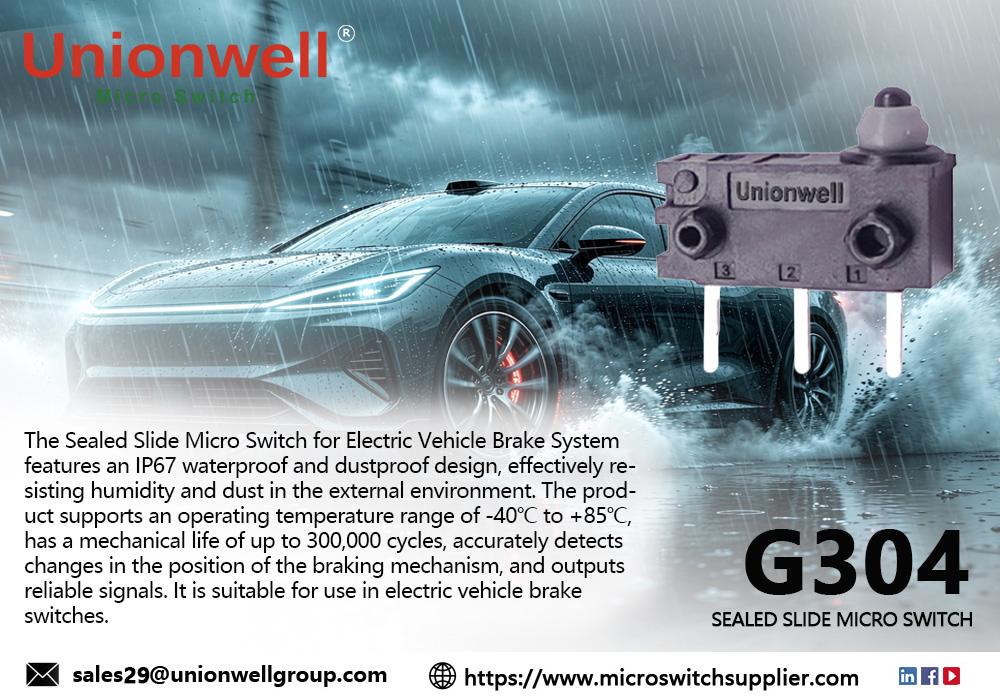
Motorcycles are frequently exposed to harsh environments involving rain, mud, and dust. If moisture or contaminants penetrate the switch, the contacts can oxidize, contact resistance can rise, and poor electrical contact may occur. Sealed micro switches isolate internal contacts from the external environment, significantly reducing the risk of contaminant ingress and ensuring stable electrical conduction under demanding conditions. For switches mounted on handlebars or external control housings, a waterproof micro switch is the primary factor determining reliability.
Stable Performance Under Vibration and Temperature Fluctuations
During operation, motorcycles are subjected to continuous road bumps and engine vibrations, while operating temperatures fluctuate significantly due to environmental conditions and engine heat. Sealed micro switches enhance vibration resistance through optimized internal structures, contact pressure, and material selection, ensuring they do not loosen or experience accidental contact actuation. Additionally, the use of wide-temperature-range materials and stable contact designs ensures consistent actuation characteristics despite temperature cycling—a critical factor for start-stop controls that undergo frequent, long-term operation.
Compact Size for Space-Constrained Handlebar Controls
Internal space within handlebar switches and control modules is extremely limited; components must be installed without interfering with the positioning or movement of surrounding mechanisms. Sealed subminiature micro switches offer a compact footprint, allowing for flexible placement within tight assemblies while maintaining stable actuation travel and electrical performance.
Long Mechanical and Electrical Life Under Repeated Operation
Start-stop buttons are operated thousands of times over a motorcycle's lifespan, requiring switches with robust mechanical and electrical durability. Sealed micro switches utilize wear-resistant materials and optimized contact structures to achieve a mechanical lifespan of up to 500,000 cycles. Combined with a snap-action mechanism that minimizes arcing time, their electrical lifespan meets the demands of frequent switching, ensuring consistent tactile feedback and signal stability throughout long-term use.
How to Choose a Sealed Micro Switch for Motorcycle Start-Stop Systems?
Electrical Ratings and Contact Configuration
First, verify that the rated current and voltage meet circuit requirements. If the switch detects low-level signals (sent to the ECU), prioritize contact reliability to ensure stable conduction at low currents; if the switch directly toggles the starter relay or a high-current circuit, account for the inrush current that occurs at startup.
Operating Force, Travel, and Actuator Type
The operating force, travel, and actuator must match the button mechanism. Excessive operating force increases resistance, while insufficient force risks accidental triggering; travel and pre-travel settings must ensure the switch actuates only when the button is fully pressed and disconnects reliably upon reset. Different actuators—such as plungers, levers, or rollers—suit different mechanical transmission methods; selection should be based on the mechanism's actual movement trajectory.
Sealing Grade, Temperature Range, and Quality Control
For outdoor operating conditions, prioritize the sealing grade (e.g., IP67) and operating temperature range to ensure stable performance in challenging environments. Additionally, the product should hold relevant safety and environmental certifications to meet market entry requirements. Selecting a manufacturer with in-house R&D capabilities, precision manufacturing processes, and a comprehensive quality control system ensures batch-to-batch consistency regarding sealing structures and contact materials.
Conclusion
With its compact, sealed structure and snap-action mechanism, the sealed micro switch provides stable mechanical position detection and ON/OFF status feedback for motorcycle start-stop controls, serving as a crucial component for the reliable operation of the vehicle's electrical system. Its core value lies in accurately converting mechanical action into signals recognizable by the ECU.
When selecting a sealed micro switch, consider factors such as installation space, direction of mechanical movement, operating force, travel, electrical parameters, service life, operating temperature, and sealing requirements. Only by ensuring a precise match between the switch—provided by the micro switch supplier—and the control mechanism can stable signal feedback be achieved under conditions involving space constraints and repetitive operation.
How Does a Slide Micro Switch Detect EV Brake Position Changes?
Related Article