Which Automotive Modules need Reliable Automotive Micro Switches?
The comfort, safety, and electrification features of modern vehicles increasingly rely on the precise detection of whether various mechanisms are correctly positioned. Whether a door is fully closed, the hood is locked, the charging port cover is open, or the lift-gate is completely shut—these seemingly simple states require a component capable of reliably converting mechanical positions into electrical signals. Errors in position detection can lead to issues ranging from false alarms and system malfunctions to serious safety hazards.
The automotive micro switch is the key component that performs this role. Featuring a compact design and a reliable snap-action mechanism, it converts mechanical states—such as locking, opening/closing, and positioning—into clear electrical signals. These signals are transmitted to the BCM (Body Control Module), ECU (Electronic Control Unit), or zonal controllers, effectively serving as the "nerve endings" of the vehicle's electronic control system. This article focuses on modules such as charging ports, door locks, hoods, and power liftgates, explaining why they require automotive micro switches to provide a deeper understanding of their importance.
Why Automotive Modules Need Automotive Micro Switches
The requirements for position detection in automotive modules generally fall into three categories:
- Safety-related: If a vehicle door, hood, or lift-gate is not securely closed, it compromises sealing, noise insulation, and security; more critically, it poses severe risks such as accidental opening while driving. Therefore, accurate detection of the locking state is essential.
- User experience-related: Features such as automatic power lift-gate operation, anti-pinch retraction, and the linkage between sun visors and vanity mirror lights all rely on knowing the precise position of the mechanism.
- Electrification-related: The charging process for new energy vehicles requires interlock systems; if the port is not fully closed or correctly locked, the system must provide a notification and restrict corresponding operations.
Automotive micro switches are widely adopted in these scenarios due to their multiple advantages:
- Compact structure: Suitable for installation within confined spaces such as lock assemblies, covers, and internal mechanisms.
- Precise actuation: Accurately reports whether a mechanism has reached the correct position.
- Rapid switching and clear signals: Features quick snap-action switching and strong resistance to interference.
- High cost-effectiveness and reliability: Capable of withstanding automotive-grade vibration and temperature fluctuations.
In summary, for locking scenarios requiring confirmation of physical engagement, the automotive micro switch offers characteristics—such as direct contact and rapid feedback—that are difficult to replicate with many other detection methods.
Four Key Automotive Modules That Require Micro Switches
Charging Port Module
In new energy vehicles, the charging port cover requires reliable open/close detection. The switch must confirm that the cover is fully open so the user can insert the charging gun, and also verify that it is fully closed to ensure protection during driving and daily use. The charging process also requires status interlocking; if the locking status is abnormal, the system should issue an alert to prevent accidental operation when the cover is not properly closed or the mechanical position is incorrect. Some models also detect whether the charging gun is inserted and correctly locked, establishing a complete safety chain for the charging process.
Car Door Lock Module
Micro switches are integrated into the door lock assembly to detect the locked and unlocked positions of the latch bolt. These switches convert the lock's status into electrical signals sent to the Body Control Module (BCM), enabling functions such as "door ajar" warnings and central locking status feedback, while also working with key-less entry systems to determine when to lock or unlock the doors. Since car doors are opened and closed repeatedly throughout the vehicle's lifespan, the mechanical longevity and operational consistency of the switch are critical.
Car Engine Hood Module
The hood lock requires position detection to confirm the hood is fully latched. If it is not properly latched, the instrument cluster issues a warning; some models may also restrict remote starting or trigger an anti-theft alert to prevent the vehicle from starting while the hood is unsecured. Automotive micro switches are also used to detect if the hood is opened; if an unexpected opening is detected, the user is alerted to prevent the hood from flying open while the vehicle is in motion.
Car Power Tailgate Module
Power tailgates rely on position feedback to enable one-touch opening/closing, anti-pinch reversal, and soft-close functions. Micro switches handle the detection of the tailgate's open/closed and latched positions, sending signals to the power tailgate control module. When an obstacle is encountered, the control module can stop or reverse the motor to prevent injury or mechanical damage; as the tailgate nears the fully closed position, the system enters the soft-close phase to ensure smooth latching.
How an Automotive Micro Switch Works in These Modules
From Mechanical Position to a Clean Switching Signal
When a latch bolt, cover plate, or mechanism moves, it actuates the switch. Once the displacement reaches the preset operating point, the switch's internal snap-action mechanism instantly releases stored spring energy, causing the contacts to snap rapidly—either connecting or disconnecting the circuit—to output a clear signal. This snap-action structure ensures a crisp, unambiguous signal, avoiding the ambiguity of a "partial contact" state and allowing the control system to accurately determine whether the mechanism has reached the correct position.
Feeding Position Signals to the BCM and ECU
The switch's output signal is transmitted via the wiring harness to the BCM, ECU, or domain controller, where it supports functions such as warning alerts, interlock logic, anti-pinch control, and automated operations. It is important to note that the automotive micro switch provides only basic status input and does not independently make vehicle-level decisions; however, the stability and consistency of the signal it provides directly determine the reliability of the higher-level control logic.
Other Automotive Applications of the Automotive Micro Switch
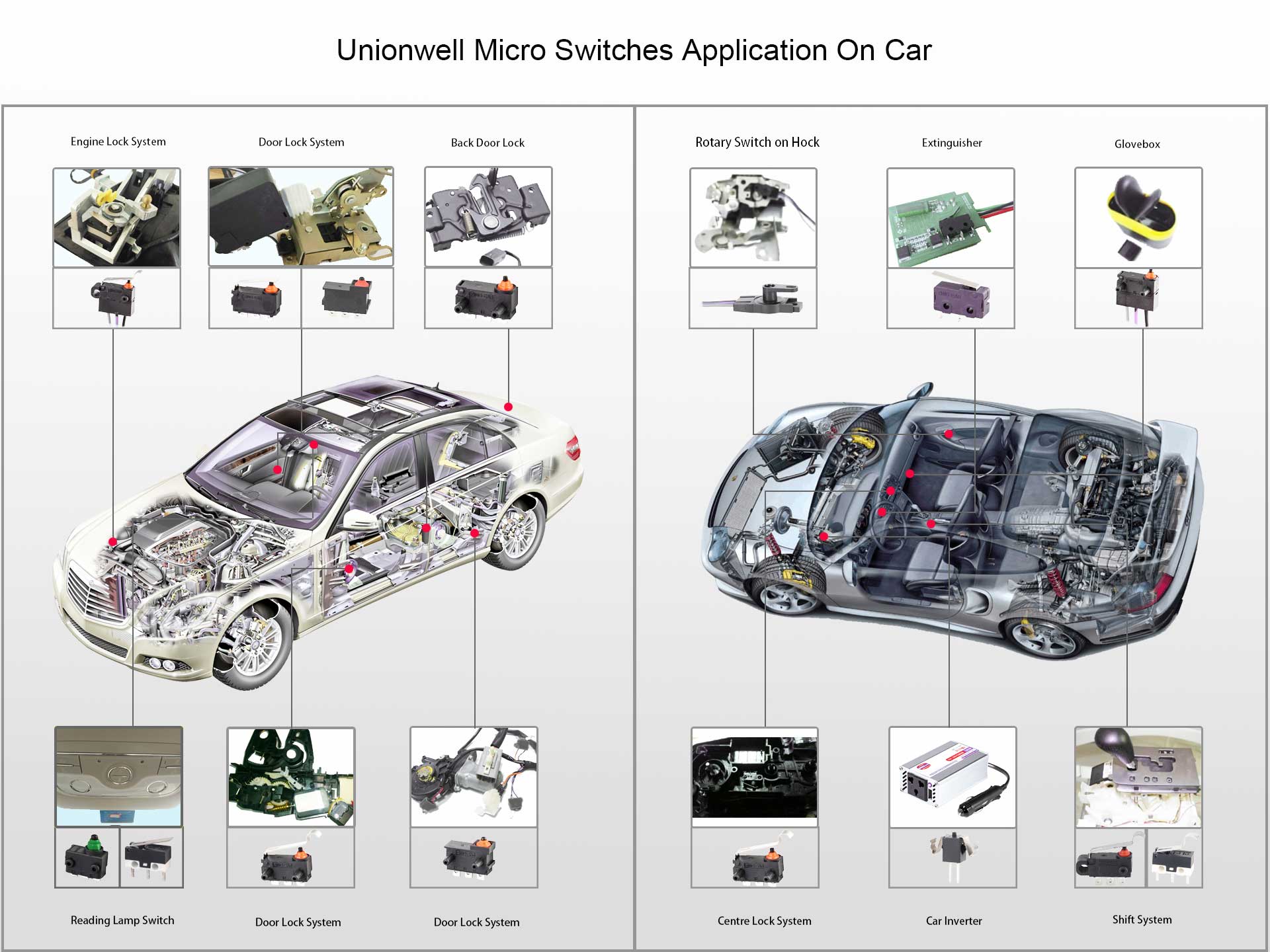
Beyond the four major modules—charging ports, door locks, hoods, and power lift-gates—automotive micro switches have a wide range of applications throughout the vehicle:
- In sun visors, the switch automatically controls the vanity mirror light based on whether the visor is flipped down;
- In brake and transmission systems, the switch detects brake pedal position, gear selection, and parking status;
- In the electronic locks of charging guns for new energy vehicles, the switch detects the locking status to prevent accidental disconnection during charging.
These applications demonstrate that, despite their small size, micro switches are indispensable fundamental components for enabling vehicle functionality.
Conclusion
In automotive systems, micro switches convert mechanical states—such as locking, opening/closing, and positioning—into clear electrical signals, providing reliable position feedback for modules including door locks, hoods, power lift-gates, and charging ports. It serves as the foundation for enabling safety and convenience features such as door-ajar alerts, automatic locking, anti-pinch tailgate functionality, and charging interlocks; it is also widely utilized in applications ranging from sun visors and brake/transmission systems to electronic locks for charging connectors.
When selecting a component, one must comprehensively evaluate electrical parameters and contact logic, operating force and travel, actuator type, sealing and operating temperature, vibration resistance, and mechanical lifespan, while also choosing a micro switch manufacturer capable of automotive-grade quality control. Only through the precise matching of the switch with the module mechanism can stable and repeatable detection performance be maintained under conditions of frequent, long-term use and complex operating environments.
Why Are Sealed Micro Switches Used for Start-Stop Control on Motorcycles?
Related Article