Why Car Door Lock Modules Choose the Shift Lever Micro Switch?
When a car door is closed, a "verification system" within the door lock module goes to work: Has the locking lever truly reached the locked position? Has the unlocking mechanism disengaged? These states are reflected by door status icons on the central control screen—data that originates from a "shift lever micro switch" located inside the door lock module.
The shift lever micro switch is compact, featuring an actuator in the form of a metal lever with a bent tip. This lever serves as an elegant solution for door lock systems, which must contend with strict constraints regarding space, motion paths, and operating environments. This article explores why door lock systems specifically favor the use of shift lever micro switches.
Table of Contents
What a Lever Adds to a Micro Switch
A micro switch operates on a simple principle: when a plunger is pressed along its axis past a critical threshold, an internal spring mechanism flips, triggering an output signal. In real-world applications, however, inputs rarely conform to this "ideal" linear motion. Locking levers may rotate, sliders may move horizontally, and cam-like protrusions may follow an arc—all of which represent non-standard triggering scenarios. Furthermore, because the switch’s mounting position and orientation are dictated by its housing, the axis of the plunger often does not align naturally with the direction of the mechanism's movement.
Adding a lever creates a mechanical interface between the mechanism's motion and the switch's trigger point, offering several key advantages:
1. Directional Conversion: The lever translates displacement from any direction into a direct, axial force on the plunger, providing complete freedom in how the switch is positioned.
2. Stroke Amplification: The length of the lever can be adjusted to modify the effective actuation stroke—a longer lever is ideal for light-touch, long-travel applications, while a shorter lever suits compact, high-precision requirements.
3. Force Adjustment: By altering the lever ratio, the required operating force can be tuned; a longer lever allows the mechanism to trigger the switch with less applied force (though this requires precise calculation during component selection).
4. Buffering and Isolation: The lever absorbs mechanical impact, preventing it from striking the plunger directly. Wear is concentrated on the tip of the lever, which can be custom-shaped to perfectly match the specific path of a cam or protrusion.
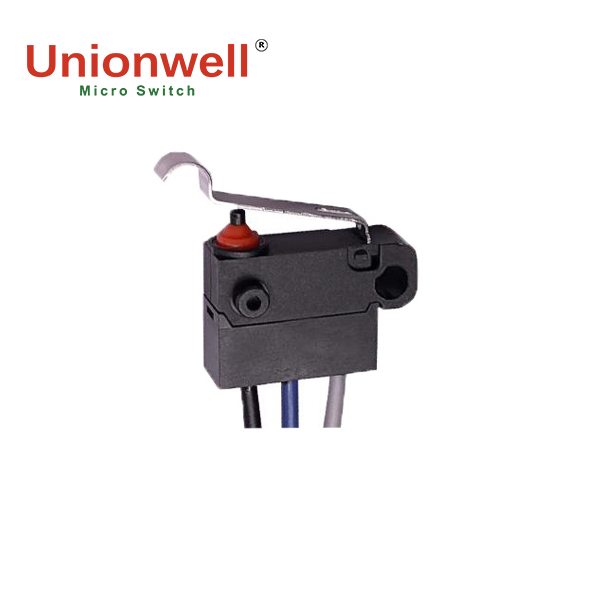
The shift lever micro switch is particularly specialized: its tip—often featuring a bend or a rotating element—is designed specifically to accommodate large-angle, non-linear motion paths. As the locking lever rotates past, the curved arm is swept along an arc, ensuring precise triggering and rapid response. Consequently, the arm’s length, bending angle, and the shape of its tip can all be engineered to align with the specific movement path of the locking module.
Why Automotive Door Lock Systems Prefer Shift Lever Micro Switches
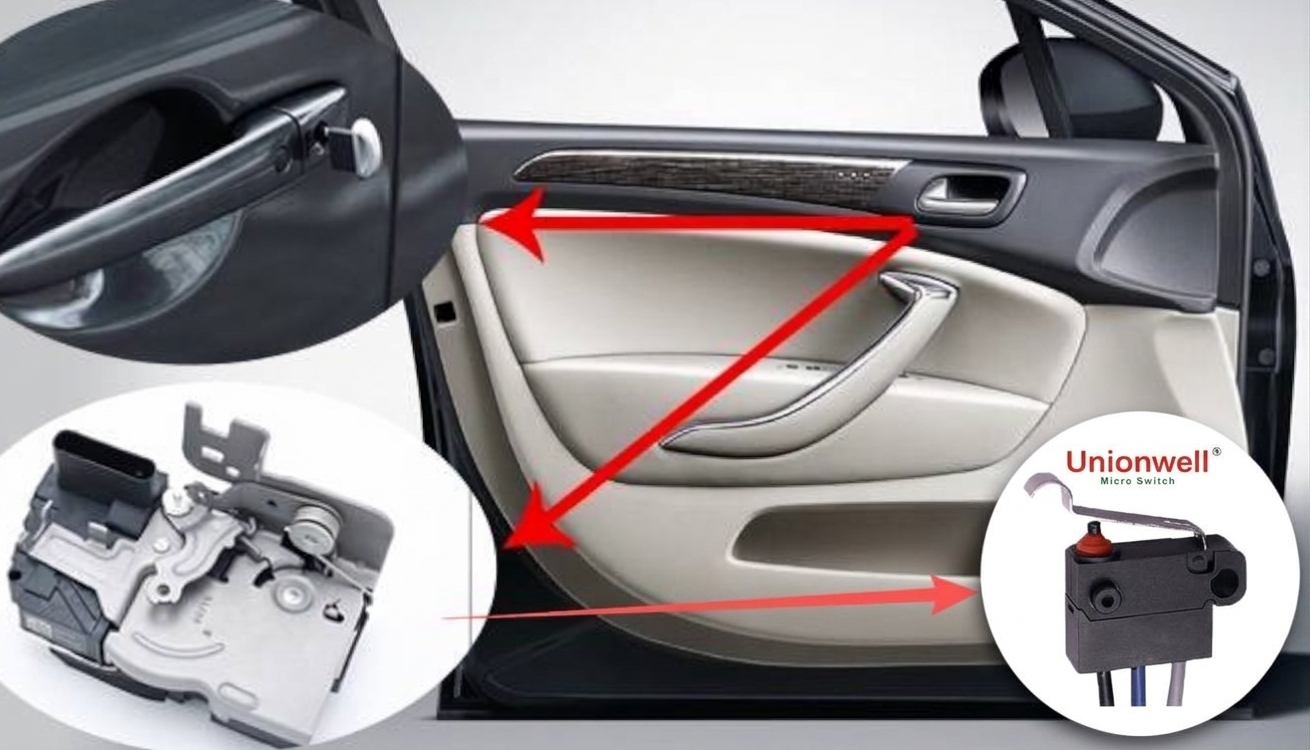
The internal structure of a door lock module is highly complex. The latch and pawl handle the actual locking mechanism, while a central locking actuator—utilizing a motor and a worm gear—drives a locking lever, causing it to pivot between the "locked" and "unlocked" positions. Space within the module is measured in millimeters, leaving little room for other types of switches. Furthermore, the movement of the locking mechanism follows a complex trajectory—a combination of rotation and translation—that is not aligned with the axis of a standard plunger-style switch, making a direct-push configuration physically unfeasible.
In contrast, the curved lever of a shift lever micro switch perfectly tracks the rotational path of the locking lever’s protruding edge. As the lever pivots into the "locked" position, its arc sweeps across the switch’s lever arm, triggering a state change; when it returns to the "unlocked" position, the arm moves in the opposite direction, triggering another state change. Each mechanical movement produces a clean, distinct signal edge, making these switches the preferred choice for automotive door lock manufacturers.
Moreover, these micro switches typically feature an SPDT configuration, where the "locked" and "unlocked" signal paths act as mirrors of each other. If neither signal is received, the system can identify a circuit fault rather than an ambiguous state, enabling effective self-diagnostics.
Door locks are subjected to impacts when doors are closed and continuous vibrations while the vehicle is in motion. It is critical to avoid any "intermediate" or indeterminate states—a risk that could arise if a switch’s internal spring mechanism were to stall mid-transition. A false "locked" signal could trigger an unintended automatic door-locking sequence or cause an anti-theft system to arm based on incorrect data; conversely, a lost signal would result in an undefined status for that door within the vehicle’s network. Consequently, detection components in door locks must meet the rigorous standards required for safety-critical parts—a key reason for selecting lever-actuated micro switches.
Why Automotive Shift Lever Micro Switches Require IP67/IP68 Protection
Within a door lock module, these micro switches are typically located inside the door cavity. During high-pressure car washes, water can be forced through the door gaps and into the cavity. When driving in the rain, water may seep in past the door seals or through drainage channels. Additionally, temperature differentials between the interior and exterior often lead to the formation of condensation within the cavity. These environmental factors necessitate that the micro switches be both dustproof and waterproof.
Consequently, some micro switch manufacturers design their shift lever micro switches to meet IP67/IP68 certification standards. These switches feature dynamic sealing around the plunger, compressed gaskets at the housing joints, and potting at the lead-wire entry point—effectively sealing the gap between the cable and the housing—to ensure these waterproof micro switches perform optimally within automotive door lock modules.
FAQ
Q1: Can the shift lever be replaced with a direct-push type or a standard straight-lever type?
A1: This depends on the travel path of the locking mechanism. The end of the locking lever moves along an arc. A direct-push mechanism requires the plunger axis to be perfectly aligned with the direction of motion, while a standard straight lever can only cover a small angular sweep; both are difficult to accommodate within the millimeter-scale confines of a door lock module.
Q2: How do the length and the bending angle of the lever arm affect the operating force?
A2: The lever converts the mechanism's thrust into an input force for the plunger, based on the ratio of the lever arms. A longer lever reduces the thrust required from the mechanism, but it also proportionally increases the effective actuation travel. The bending angle determines the length of the contact segment between the lever arm and the travel path; a longer contact segment allows for a more forgiving actuation range, though the consistency of the actuation point becomes more dependent on the precision of the lever tip's shape.
Q3: Should an SPDT switch or two SPST switches be used for door lock detection?
A3: An SPDT switch is recommended. Beyond the benefits of reduced space requirements, fewer wire harnesses, and lower assembly costs, the two states of an SPDT switch are inherently mirrored—locking and unlocking can correspond to two distinct positions of the same lever. Furthermore, if neither state is detected, the system can identify a circuit fault—a diagnostic capability that single-circuit (SPST) configurations cannot provide.
Q4: What criteria are used to evaluate the lifespan of this switch?
A4: Evaluation is based on both mechanical and electrical lifespan. Mechanical lifespan is calculated based on 20–50 door opening/closing cycles per day; a specification of 300,000 to 1,000,000 cycles provides an ample safety margin. Electrical lifespan is assessed according to the specific load; since door lock detection involves a low-level signal circuit, an electrical lifespan of 50,000 to 100,000 cycles is sufficient.
Q5: If the central control screen indicates that a door is open when it is actually closed securely, what is the recommended troubleshooting sequence?
A5: First, determine whether the fault is isolated to a single door (if multiple doors report the same issue, it is likely a problem with the vehicle bus or the body control module). Next, use a diagnostic tool to check if the two status signals (locked/unlocked) for the affected door can be toggled; if they can, the issue lies within the travel range of the locking mechanism. Then, inspect the contact between the switch’s curved lever arm and the actuating cam/lever to ensure there is no deviation from the intended motion path. Finally, measure the operating force of the switch; aging or swelling of the sealing components can increase the required operating force, potentially preventing the lever from reaching its full, intended position.
Conclusion
A variety of lever designs allow micro switches to be integrated into virtually any mechanism—enabling functions such as directional changes, force amplification, motion conversion, and cushioning—which greatly enhances design flexibility. Specifically, a "shift lever" (or shaped actuator arm) is well-suited for door lock modules; its curved profile aligns with the rotational path of the locking actuator, while its SPDT dual-circuit configuration supports the full logic required for central locking, anti-theft systems, and automatic speed-sensing door locks. Furthermore, an IP67/IP68 waterproof rating ensures the switch can survive the entire lifespan of the vehicle, even within the semi-submerged environment of a door cavity—a capability that relies on the integrity of all three sealing points.
For engineers, the selection process should begin by mapping out the mechanical motion path, followed by determining the appropriate lever length and bend angle. Next, verify the SPDT dual-circuit status and the circuit’s self-diagnostic capabilities. Finally, specify the required IP rating based on the operating conditions within the door cavity. By following these steps, the specifications for a shift lever micro switch—customized specifically for a vehicle door lock—are established.
Why Do Coffee Machines Require Miniature Micro Switches?
Related Article