Why Does a Push Rod Motor Need a Miniature Micro Switch for Limit Control?
The push rod motor is a crucial actuator for linear motion in many automated devices. It converts the motor's rotational motion into the extension and retraction of a push rod by driving a lead screw, gears, or other transmission mechanisms. A key characteristic is its defined linear mechanical stroke, meaning the motor control system needs to confirm whether the push rod has reached the designated mechanical position.
Therefore, reliable detection of the push rod's status is a critical aspect of linear actuator design. A miniature micro switch, which can determine the actuator's position based on internal contact states and stop or change motor operation according to preset logic, is a suitable choice. This article will focus on why it is suitable for limit control of push rod motors and how it performs end-position detection and status feedback.
Why Does a Push Rod Motor Need a Micro Switch for Limit Control?
The push rod motor converts rotational motion into linear motion through a transmission mechanism, with a defined mechanical stroke. The main end positions include full extension and full retraction. Without limit detection, the motor may continue running after the push rod reaches its end position, subjecting the gears, lead screw, and transmission mechanism to additional loads.
A miniature micro switch can function as a limit switch for this detection task. When the push rod, slider, cam, or gear reaches the designated position, it actuates the actuator, causing the internal contacts to switch rapidly and output an electrical signal. At this point, the micro switch primarily converts the mechanical position into an electrical state, helping the control system determine whether the push rod has reached the End Position. Stopping the motor, changing direction, or executing the next action are handled by the subsequent control system.
Micro Switch Detects the End Position of the Push Rod
During the operation of the push rod motor, components such as the push rod, slider, cam, or gear will experience mechanical displacement. Designers can set the detection position so that when the moving parts reach their positions, they actuate the miniature micro switch's actuator, causing the internal contacts to switch and output an electrical signal, thus converting the mechanical position into a identifiable switching state.
In practical applications, the Actuation Position, Operating Force, Actuator type, and installation position must match the mechanism. Triggering too early may result in premature output of the end signal, while triggering too late may increase the load on the mechanism. Therefore, the micro switch needs to be designed appropriately based on the actual stroke of the push rod motor and the mechanism's tolerances.
How Does a Micro Switch Control Push Rod Motor Limits?
In a push rod motor limit system, a miniature micro switch establishes a clear signal chain: Push Rod Movement → Actuator Contact → Contact Switching → Electrical Signal → Control Circuit → Motor Stop.
When the push rod or related mechanism approaches the target position, it actuates the micro switch's actuator, causing the internal contacts to switch rapidly and output an ON/OFF signal. The control circuit reads this state to determine if the push rod has reached the designated position.
If the switch is used for extension limit, the signal represents "extended end in place"; if used for retraction limit, it represents "retracted end in place." For dual-end limit systems, the design must also consider the direction of movement, mechanical tolerances, and control logic to ensure accurate matching between the two detection points and their corresponding positions.
Micro Switch Supports Extension and Retraction Limit Detection
Many push rod motors require detection of both fully extended and fully retracted end positions; therefore, miniature micro switches can be installed at both ends. The extension switch is triggered when the push rod reaches its maximum stroke, while the retraction switch is triggered when it is fully returned to its original position.
The control system determines the actuator's position status through two independent signals. In this case, the miniature micro switch acts as a limit switch, providing discrete feedback for the two boundary positions. During actual installation, the actuator can be driven via a cam, slider, or other mechanism to ensure accurate and stable matching between the mechanical position and the switch trigger point.
Where is a Micro Switch Used in Push Rod Motor Systems?
A miniature micro switch is not necessarily directly mounted on the outside of the push rod; its specific location depends on the structural design of the push rod motor.
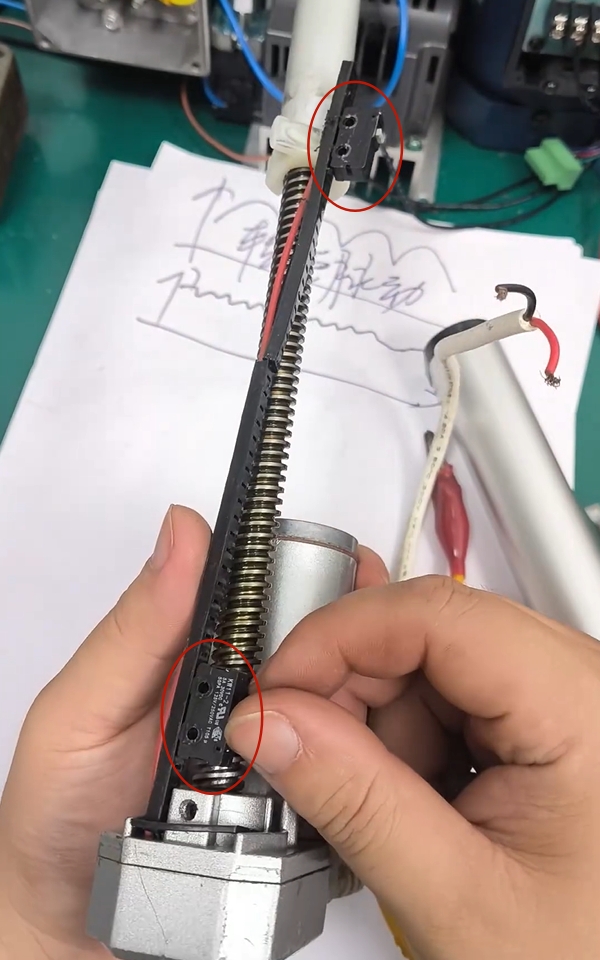
Micro Switch for Linear Actuator Position Detection
Electric push rods are linear actuators, and their range of motion is typically determined by the screw length, mechanical stops, and overall structure. For equipment requiring a precise end position, a miniature micro switch can be used to detect whether the push rod is fully extended or retracted.
When the push rod reaches the set position, the micro switch is activated by the mechanical structure, causing a change in the contact state. The control system then determines whether the actuator is in position. This method is suitable for applications that only need to confirm boundary states, without requiring real-time acquisition of specific displacement to determine whether the extended or retracted end has been reached.
Micro Switch for Automated Equipment
Push rod motors are commonly used in automated equipment for lifting, pushing, positioning, and adjustment. Lifting mechanisms need to detect upper and lower limit positions, door mechanisms need to confirm open and closed states, and positioning mechanisms need to determine whether components have reached designated positions. These applications all require the control system to accurately acquire the mechanical state of the actuator.
A miniature micro switch can be installed at the corresponding detection position. When the push rod or related mechanism completes its action, it pushes the actuator, causing the contacts to switch and output a status signal. The control system uses this signal to confirm whether the mechanism is in position. Therefore, as a position detection interface between the mechanical structure and the control system, the micro switch's simple ON/OFF signal can meet basic control requirements for discrete states such as "in position" and "not in position".
Key Benefits of Using a Micro Switch for Push Rod Motor Limit Control
In push rod motor limit control, the micro switch can convert the push rod's end position into a definite electrical signal through mechanical triggering. Compared to complex position detection schemes, using a miniature micro switch for push rod motor limit control has the following main advantages:
- Compact Design: The miniature micro switch is small in size, making it easy to install in push rod motors with limited space, reducing the impact on the layout of gears, guide rails, brackets, and connectors.
- Reliable Switching Performance: The micro switch provides stable status feedback, meeting the repetitive limit detection requirements of high-frequency extension and retraction in push rod motors.
- Simple Limit Detection: The micro switch directly provides clear boundary status signals, indicating whether the push rod has reached the fully extended or fully retracted position.
- Easy Integration with Control Systems: The micro switch directly converts mechanical position into electrical signals, facilitating motor stop, reverse, or further motion control.
- Balanced Cost and Functionality: For push rod motors requiring only "in-position/out-of-position" judgments, the micro switch achieves a good balance between structure, cost, and detection functionality.
Conclusion
In push rod motors, the miniature micro switch primarily serves for end-position detection, limit status feedback, and control circuit input. For push rod motors requiring detection of fully extended and fully retracted positions, the miniature micro switch offers a compact, clear signal, and repetitive mechanical motion detection solution.
As a micro switch supplier, we cannot only focus on the switch size when choosing a micro switch for a push rod motor. We also need to comprehensively consider factors such as the actuator, operating force, actuation position, and mechanical life to ensure that the micro switch and the mechanical structure and control circuit of the push rod motor can be stably matched in the long term.
How Does a Miniature Micro Switch Work in a Blood Pressure Monitor?
How Automotive Micro Switch Supports Safety Restraint Systems
Related Article