SPST vs. SPDT vs. DPST vs. DPDT Switch:Their Differences And Use Cases
The switch is the control component responsible for opening the circuit, and the core of a switch is still concerned with the circuit itself. There are also many types of circuits, including SPST (Single Pole Single Throw), SPDT (Single Pole Double Throw), DPST (Double Pole Single Throw), DPDT (Double Pole Double Throw) and other circuits. This article can help you better understand the differences and applications between various circuits.
What is a Circuit Switch?
A circuit switch is a basic component used to control the current break. They are divided into different types of switches based on how they control the circuit and how they are connected, named after different poles (the number of independent circuits controlled by the switch) and throw (the number of different positions that the switch can connect to each pole).
The difference between the various circuits
SPST(Single Pole Single Throw)
SPST is short for the Single Pole Single Throw Switch Type, which is the simplest type of circuit switch. This type of switch is characterized by having only one input and one output, and the wiring is simple. When the input terminal is connected to the output terminal, the circuit is in the connected state; Conversely, if it is disconnected, it will be closed.

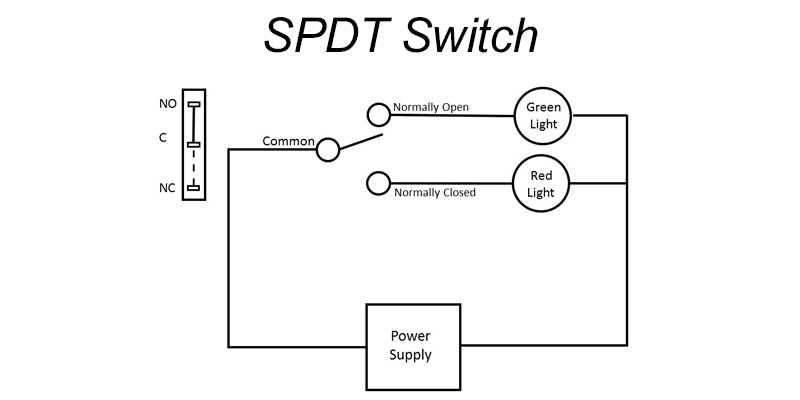
SPDT(Single Pole Double Throw)
The full name of SPDT is Single Pole, Double Throw, which means that this type of switch has one input (pole) and two output (throw), and it can choose to switch between two circuit paths. Unlike SPST, SPDT switches have three terminals, one of which is the input and the other two are the output. In practice, there is the option of connecting an input to one of the outputs while the other is disconnected.
DPST(Double Pole Single Throw)
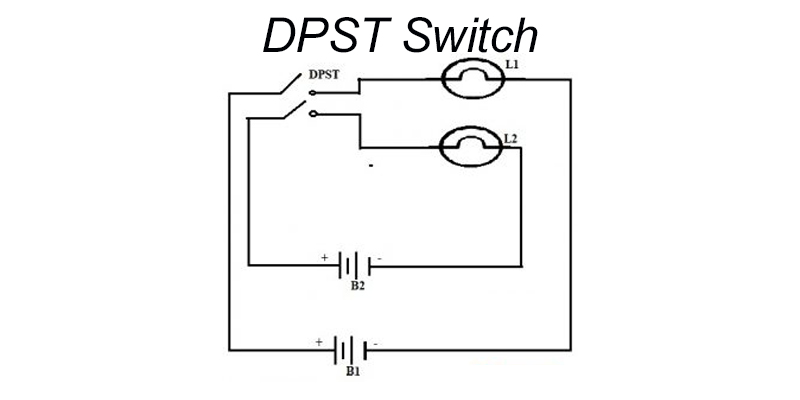
DPST stands for Double Pole, Single Throw, and according to the law, we can know that it is a circuit with two sets of inputs and one output. This type of circuit can control the output of two different circuit paths, and can be used as two SPST circuits, usually used to control two independent circuits.
DPDT (Double Pole Double Throw)
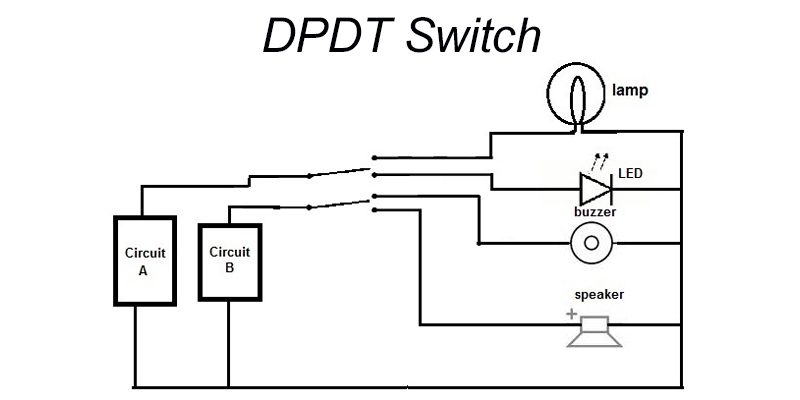
The DPDT circuit is more complex than the previous three, with a total of 6 contacts and divided into two groups: one input and two outputs for each group, and the circuit structure is like a combination of two SPDT circuits. Due to the variety of combinations of these circuit options, they can be used to control more complex circuit switching or electrical control.
Advantages and disadvantages of various types of circuit switches
SPST Advantages
- The circuit of the SPST switch is simple to use, easy to understand and easy to install.
- It is inexpensive to manufacture and suitable for mass production and use.
- Due to the simple internal structure and few internal mechanical or electrical parts, it has high reliability and service life, and is also easy to maintain.
SPST Disadvantages
- The function is too simple, and SPST can only control one circuit to achieve a simple switching function.
- Due to design limitations, SPST switches are unable to withstand high current loads and are limited in industrial or professional applications.
- SPST can only switch the state of the circuit in one direction, which is difficult to adapt to the complex circuit requirements in practical applications.
SPST Application
The simple design of SPST switch is commonly used in ordinary household switches to simply control lamps, fans, etc. In small electronic devices, SPST switches can be used to switch on and off the power supply to control simple on/off functions. In addition, SPST switches are the best choice for basic functional applications that require simple control and low cost, and although SPST switches have limited functionality, they are a cost-effective option for production applications.
SPDT Advantages
- SPDT switches can control two different circuit forces, which is more flexible than SPST switches and better implements some more complex functions.
- The circuit design is simple and easy to understand, although it is more complex than SPST, but the circuit is clear and easy to understand, and it is more stable and reliable.
- Widely used, common in the electronics market, easy to replace.
- It has a higher current tolerance and can operate at high voltages and currents.
SPDT Disadvantages
- Connecting an SPDT circuit correctly requires certain expertise, and there is a certain risk of incorrect operation.
- Despite its wide applicability, SPDT may not suffice for highly specialized equipment, while its use in simple circuits can be seen as overly complex and cost-prohibitive.
- It is less user-friendly for those unfamiliar with circuits compared to SPST circuits, adding to installation challenges.
SPDT Application
The SPDT has two independent circuits that can be used to switch modes or signals in the control of electronic devices. It can be used in household appliances to adjust gears or set the time. In industry, SPDT circuits can be used for motor control to reverse the direction of rotation of the motor.
DPST Advantages
- DPST switches are simple in structure, reliable in operation, and usually not prone to failure.
- It is suitable for basic control circuits, such as simple circuit switches or start-stop electrical equipment.
- Each group of contacts can be independently galvanically isolated, helping to ensure safe operation and circuit separation.
DPST Disadvantages
- The function is limited, and each group of contacts can only control the switching state of one circuit, making it difficult to achieve complex multi-function control.
- Since there are two separate circuits, if there is a problem with one of the circuits, more complex maintenance and troubleshooting steps are required, adding to the maintenance difficulties.
- It adds operational complexity for users who are not familiar with circuits.
DPST Application
DPST switches are typically used in applications that require independent control of two circuit paths or require additional safety protection, such as in communication equipment or control systems, where DPST switches can be used to select different signal sources or control lines, providing greater flexibility and reliability.
DPDT Advantages
- DPDT switches can control two completely independent circuit paths, thus providing more complex control and more diverse operating options.
- With multiple circuit designs, it can also withstand higher currents and long operating hours, making it suitable for applications that require greater current capacity.
- Adapting to a variety of complex circuit requirements, DPDT switches can provide more flexible and precise control when multiple functions need to be switched.
- DPDT switches can withstand high power or special requirements and can be used in highly specialized equipment.
DPDT Disadvantages
- The space occupies a large area, because it contains a variety of circuits inside, it occupies more space, and there are certain requirements for the application site.
- High complexity, difficult to understand, a variety of internal lines and contacts, complex wiring, difficult to understand and maintain.
- Due to the changeable line, there are certain professional requirements for operators, which increases the risk of misoperation.
- Compared to simple SPST switches, DPDTs are more expensive, especially in high-power or special environments.
DPST Application
Due to the wide range of circuit options, DPDTs can be used in the lab or test equipment to select different circuit configurations for testing or analysis. In communication and electronic devices, DPDT switches can be used to switch signal paths, such as switching antennas or signal reception sources. These are just a few examples of common applications for DPDT switches, and their versatility has led to their widespread use in the field of electronics and electrical engineering.
Hopefully, this article can help you have a deeper understanding of circuit switches. Different circuit switches are used in different occasions, and specific circuit switches should be selected according to the actual situation.
Four Applications of Micro Switches in Cars
Definition and Application of Snap Action Swiches
Related Article